- Contact Us
-
Material
Leather and urushi lacquer
-
Size
20 x 15 x 30 (h) cm
-
Period
2026
Description
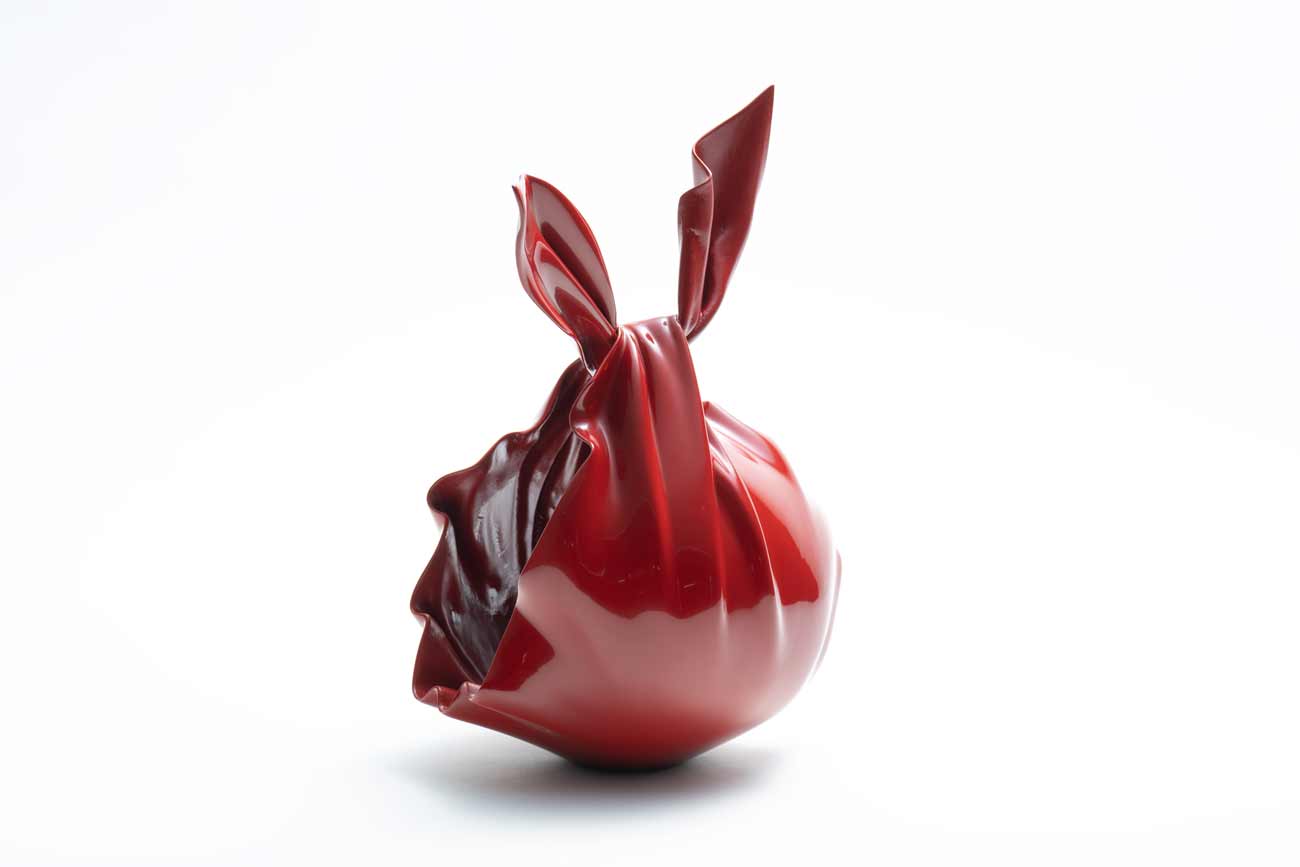
In Lovely Knot, Wei Nan transforms leather into a knotted, unfolding form, whose folds retain the appearance of a supple material despite the sculpture’s rigidity. The deep red urushi, enlivened by its glossy surface, accentuates the tensions, curves, and folds that structure the work. Somewhere between a knot, an envelope, and a form in bloom, the sculpture seems to capture the material at the very moment it contracts and opens.
Wei Nan (b. 1994, China)
Born in Beijing in 1994, Wei Nan is a Chinese artist who trained in lacquer techniques in Japan for eight years. After studying lacquer and wood arts in Saga, on the island of Kyushu, she continued her research at Kyoto City University of Arts, where she earned a doctorate in lacquer. She now lives and works in Kyoto.
Wei Nan has chosen a material that remains unusual in contemporary urushi practice: leather. Her work draws in particular on shippi, an ancient technique that emerged in Japan during the Asuka period, whose sculptural possibilities she explores and renews. The leather is first stretched and shaped over a mould, then gradually hardened through the successive application of several layers of lacquer. The structure is subsequently reinforced with linen before receiving further layers of urushi, which give it strength, thickness and depth.
The choice of leather is fundamental to the construction of her works. Whereas wood imposes the resistance of the material, the direction of the grain and the constraints of carving, leather offers an elasticity that allows Wei Nan to explore freer curves, folds, twists and unfolding forms. Urushi therefore does not simply cover the material: applied layer after layer, it transforms and gradually hardens it, fixing the original tension of the leather within the finished form.
Her formal vocabulary draws on the observation of nature and its movements. The blossoming of a flower, the undulation of a wave or the movement of the wind become starting points for organic volumes that appear to unfold into space. Wei Nan translates these phenomena into folds, edges, hollows and curves, bringing together the suppleness suggested by the form and the density created by the accumulation of layers of lacquer. The depth and lustre of the urushi accentuate these contours and alter the perception of the work according to the light and the viewer’s perspective.
This exploration is rooted in a close relationship between gesture, material and time. The surface retains traces of the tensions exerted on the leather and of the slow process through which the work is constructed. Wei Nan describes her practice as a way of engaging with the world and conveying a contained energy through her sculptures. Her forms thus emerge gradually, layer after layer, until they reach a balance between movement and stability.
Wei Nan’s work has received several distinctions in Japan and internationally. She received a Student Award at the Japan Crafts Exhibition in 2018, followed by an Encouragement Award in 2020. That same year, her work was selected for the International Urushi Exhibition Ishikawa. In 2021, she received a Special Prize at the Cheongju International Craft Competition in South Korea, as well as the Grand Prize at the Art Meets Architecture Competition in Tokyo for her work Power of Flower.
Her works have been presented at several international events, including Collect in the United Kingdom, Fine Art Asia in Hong Kong and Kōgei Art Fair Kanazawa. In 2024, her work was presented in Paris by Galerie Mingei in the exhibition URUSHI, Contemporary Lacquers from Japan. One of her works has also entered the collection of the Victoria and Albert Museum in London.
In 2026, Wei Nan was a finalist for the LOEWE Craft Prize, with the finalists’ works presented in Singapore.
«